U.S.-Taiwan Trade Deal: 15% Tariff Agreement with $500 Billion Investment Commitment
Unlock More Features
Login to access AI-powered analysis, deep research reports and more advanced features
About us: Ginlix AI is the AI Investment Copilot powered by real data, bridging advanced AI with professional financial databases to provide verifiable, truth-based answers. Please use the chat box below to ask any financial question.
Related Stocks
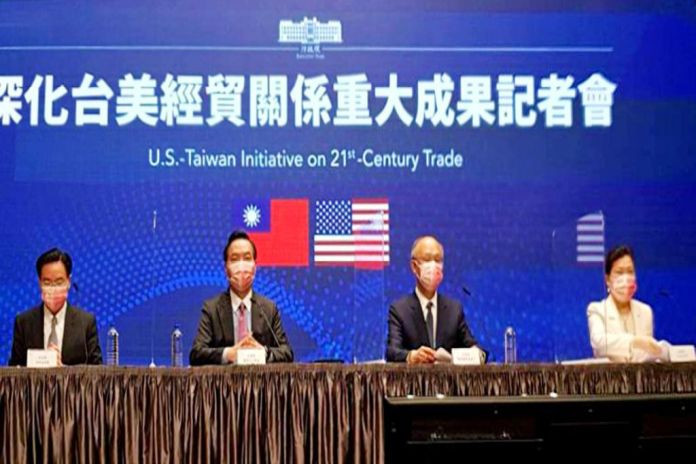
On February 12, 2026, the United States and Taiwan finalized a comprehensive trade agreement that represents one of the most significant bilateral economic pacts between the two parties in recent years [1][2]. The agreement establishes a 15% tariff rate on U.S. imports of Taiwanese goods, down from the 20% rate implemented earlier in the year, providing immediate relief for Taiwanese exporters, particularly in the semiconductor industry [1]. In exchange, Taiwan has committed to eliminating or reducing tariff barriers on approximately 99% of U.S. goods, with specific provisions for “preferential market access” targeting American industrial and agricultural products [1].
Beyond tariff adjustments, the deal includes substantial investment commitments from Taiwan, with $250 billion in direct investment and an additional $250 billion in government-backed credit guarantees pledged over the coming years [3]. These commitments are expected to unlock significant capital flows into U.S. manufacturing, infrastructure, and technology sectors, with reports indicating that TSMC’s $465 billion Arizona expansion may be partially unlocked by this agreement [5]. The reciprocal nature of the deal positions both parties as beneficiaries: Taiwan gains improved access for its technology exports while the United States secures enhanced market penetration for its agricultural and industrial goods.
The immediate market response to the trade announcement revealed divergent performance patterns across different market segments [0]. U.S. major indices experienced notable declines on February 12, with the S&P 500 falling 1.79%, the NASDAQ dropping 2.36%, the Dow Jones Industrial Average declining 1.71%, and the Russell 2000 suffering a 2.58% loss [0]. However, these declines appear to reflect broader market risk-off sentiment rather than a direct negative reaction to the Taiwan agreement, as the tech-heavy NASDAQ’s pronounced weakness may indicate rotation away from high-valuation names rather than semiconductor-specific concerns.
Taiwan Semiconductor Manufacturing Company (TSMC) emerged as a clear beneficiary of the deal, with shares rising approximately 5% following the announcement [5]. This positive reaction aligns with expectations given that the tariff reduction directly improves the competitive positioning of Taiwanese semiconductor exports in the U.S. market. The semiconductor sector more broadly benefited from the deal’s confirmation of strong U.S.-Taiwan economic cooperation, which reinforces supply chain relationships critical to both economies.
The trade agreement creates differentiated impacts across various sectors, with semiconductor and technology firms positioned as primary beneficiaries while certain Taiwanese export industries face new pressures [3]. For U.S. agricultural exporters, particularly those in corn, soy, and pork industries, the removal of 99% of Taiwan’s tariff barriers represents a significant market access improvement that could substantially increase export volumes to the Taiwanese market over the implementation timeline.
Conversely, Taiwan’s auto parts industry confronts meaningful headwinds, as the new 15% tariff represents a six-fold increase from the previous 2.5% rate [3]. This tariff disparity within the same agreement highlights the negotiated nature of the deal and the varying negotiating positions of both parties across different industrial sectors. Taiwanese auto component manufacturers may need to adjust production strategies, pricing models, or supply chain configurations to maintain competitiveness in the U.S. market.
The U.S.-Taiwan trade agreement carries significant geopolitical implications that extend beyond immediate economic considerations [3][4]. Beijing’s characterization of the deal as “subservience to Washington” signals potential diplomatic friction and raises questions about possible retaliatory measures from China [3]. The timing of the agreement, amid ongoing U.S.-China trade tensions and security concerns regarding Taiwan, positions this deal as both an economic instrument and a strategic signal regarding U.S. commitment to Taiwan’s economic viability.
The agreement also highlights the ongoing strategic dependency of the U.S. semiconductor supply chain on Taiwan, reinforcing rather than reducing long-term reliance on Taiwanese chip manufacturing capabilities [4]. While the deal improves terms for this critical supply relationship, it does not address fundamental questions about supply chain resilience or diversification that have been priorities in U.S. industrial policy discussions.
The $500 billion total investment commitment from Taiwan—comprising $250 billion in direct investment and $250 billion in government-backed credit guarantees—represents a substantial capital commitment that could reshape U.S. industrial capacity in key sectors [3]. The reported connection to TSMC’s Arizona expansion suggests that these investment flows will be directed partially toward domestic semiconductor manufacturing capacity, supporting broader U.S. objectives of reducing dependence on overseas chip production while creating high-skilled manufacturing employment opportunities.
The preferential market access provisions for U.S. industrial and agricultural exports merit close attention as implementation details emerge, as these provisions could reshape trade patterns in sectors where Taiwan has historically maintained protectionist barriers. Success in capturing this expanded market access will depend on U.S. exporters’ ability to meet Taiwanese demand patterns and compete effectively with other international suppliers.
The February 12, 2026 U.S.-Taiwan trade agreement establishes a 15% tariff rate on U.S. imports of Taiwanese goods with Taiwan removing or reducing 99% of tariff barriers on U.S. products and committing $500 billion in investment flows [1][2][3]. Market reaction was mixed, with TSMC shares rising approximately 5% while major U.S. indices declined amid broader risk-off sentiment [0][5]. The deal strengthens economic ties between Washington and Taipei while introducing potential geopolitical tensions with Beijing, which criticized the agreement [3]. Sector impacts vary significantly, with semiconductor and agricultural exporters positioned as primary beneficiaries while Taiwan’s auto parts industry faces substantial tariff increases [3]. Investment commitments linked to the deal may unlock significant U.S. manufacturing capacity expansion, particularly in semiconductor fabrication [5].
This analysis is based on the CNBC report [1] published on February 12, 2026, supplemented by market data [0] and corroborating sources [2][3][5]. Professional skepticism has been applied to preliminary market reactions and implementation details that require verification as the agreement progresses toward execution.
Insights are generated using AI models and historical data for informational purposes only. They do not constitute investment advice or recommendations. Past performance is not indicative of future results.
About us: Ginlix AI is the AI Investment Copilot powered by real data, bridging advanced AI with professional financial databases to provide verifiable, truth-based answers. Please use the chat box below to ask any financial question.