Impact of IAEA-Iran Negotiations on Global Oil Supply Chains and Energy Markets
Unlock More Features
Login to access AI-powered analysis, deep research reports and more advanced features
About us: Ginlix AI is the AI Investment Copilot powered by real data, bridging advanced AI with professional financial databases to provide verifiable, truth-based answers. Please use the chat box below to ask any financial question.
Based on my research, here is a comprehensive analysis of how the outcome of IAEA-Iran negotiations could impact global oil supply chains and energy markets:
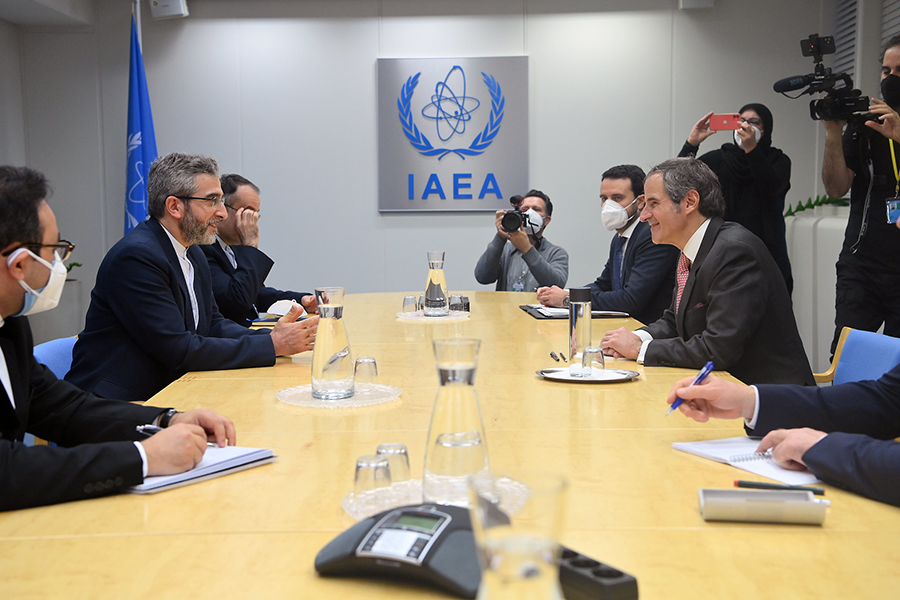
IAEA Director General Rafael Grossi has confirmed that dialogue with Tehran has resumed following the US-Israel strikes on Iranian nuclear facilities. The negotiations are complex, with decisions expected in the coming days [1][2]. Iran announced in early 2026 that Washington has agreed to remove all sanctions on Iran’s oil and shipping sectors, potentially marking a significant shift in the geopolitical landscape [3].
According to energy analysts, there are five primary scenarios for the Iran nuclear situation, each with distinct implications for oil markets [4]:
- Oil Price Impact:Downside risks to prices would belimited and gradual
- Supply Increase:Iran could add approximately1-2 million barrels per dayto global supply
- Market Response:OPEC+ would likely adjust production quotas to stabilize prices
- Timeline:Any increase in Iranian exports would occur gradually over months
- Partial removal of sanctions on oil and shipping only
- Modest increase in Iranian exports, primarily to China and other Asian markets
- Limited impact on global prices due to existing supply constraints
- Current sanctions regime remains in place
- Iran continues exporting through灰色渠道 (gray channels), mainly to China
- Market already pricing in limited Iranian supply
- Further military conflict or new sanctions
- Potential oil price spike: BloombergNEF estimates Brent crude could rise to$71/bblin Q2 2026 in an extreme disruption scenario [5]
- Risk premium of approximately $4 per barrelcurrently built into crude prices [5]
- Iran completely removed from market starting February 2026
- Brent could average $91 per barrelin late 2026 [5]
- Would significantly tighten global supply fundamentals
- Iran is the 5th largest crude oil producer in OPEC+, pumping roughly3.3 million barrels per day[5][6]
- Oil production rose by 34,000 bpd to 3.308 million bpd in February 2025 [6]
- Domestic refinery capacity: 2.6 million bpd[7]
- 2025 oil product exports: nearly 820,000 bpd[7]
- Chinaaccounts for more than $14.5 billion of Iran’s $56 billion in total exports (approximately 26%) [8]
- Significant volumes also go to Iraq, the UAE, and Turkey
- Despite sanctions, Iran has maintained exports primarily through Chinese purchases
- Price Volatility: Uncertainty around negotiation outcomes will maintain elevated volatility
- Shipping & Logistics: Potential easing of sanctions could normalize tanker traffic through Strait of Hormuz
- Asian Refiners: Chinese and Indian refiners would be primary beneficiaries of increased Iranian crude availability
- OPEC+ Dynamics: The cartel would need to recalibrate production allocations
- Sour vs. Sweet Crude: Market balance would shift toward more sour grades [9]
- Investment Flows: Potential normalization of capital flows into Iran’s energy infrastructure
- Global Supply Architecture: Restructuring of traditional supply routes
- Price Competition: Increased competition could pressure other producers (Russia, Venezuela)
- Renewable Energy Impact: Lower oil prices from increased supply could temporarily reduce renewable energy competitiveness [10]
- Verification Challenges: IAEA inspections remain contentious, with Iran previously suspending cooperation over access demands [2]
- US Political Considerations: Any nuclear deal faces political opposition domestically in both Washington and Tehran
- Regional Security: Israeli opposition to any Iran nuclear accommodation adds geopolitical risk
- Enforcement Mechanisms: Sanctions relief verification and monitoring mechanisms
The outcome of IAEA-Iran negotiations represents one of the most significant potential supply shocks in the global oil market. While a comprehensive deal could add substantial supply to a market that has been tight, analysts note that
For energy market participants, the coming days will be critical in determining whether the global oil supply outlook becomes more or less constrained.
[1] TASS - “IAEA chief says agreement on nuclear inspections with Iran may be reached in coming days” (https://tass.com/world/2086643)
[2] The Straits Times - “Iran, UN nuclear watchdog reach understanding on cooperation” (https://www.straitstimes.com/world/middle-east/iran-un-nuclear-watchdog-reach-understanding-on-cooperation)
[3] Anadolu Agency - “Iran says US reconciled to lift oil, shipping sanctions” (https://www.aa.com.tr/en/energy/nuclear/iran-says-us-reconciled-to-lift-oil-shipping-sanctions/33033)
[4] OilPrice.com - “Five Scenarios for Iran and What They Would Mean for Oil Markets” (https://oilprice.com/Energy/Energy-General/Five-Scenarios-for-Iran-and-What-They-Would-Mean-for-Oil-Markets.html)
[5] BloombergNEF - “Oil Can Hit $91 a Barrel in Late 2026 on Iran Disruption” (https://about.bnef.com/insights/commodities/oil-can-hit-91-a-barrel-in-late-2026-on-iran-disruption/)
[6] Tehran Times - “Iran’s oil industry posts fresh records in output, exports, capacity building” (https://www.tehrantimes.com/news/523537/Iran-oil-industry-posts-fresh-records-in-output-exports-capacity)
[7] BOE Report - “An overview of Iran’s main gas field and oil infrastructure” (https://boereport.com/2026/01/23/an-overview-of-irans-main-gas-field-and-oil-infrastructure-2/)
[8] Visual Capitalist - “Charted: Iran’s Top Export Destinations” (https://www.visualcapitalist.com/cp/irans-top-export-destinations/)
[9] Kpler - “Crude oil: Top 5 market drivers in 2026” (https://www.kpler.com/blog/crude-oil-top-5-market-drivers-in-2026)
[10] Discovery Alert - “Iran Nuclear Deal Oil Impact: Global Energy Markets in 2026” (https://discoveryalert.com.au/iran-nuclear-deal-oil-impact-2026-pricing-dynamics/)
Insights are generated using AI models and historical data for informational purposes only. They do not constitute investment advice or recommendations. Past performance is not indicative of future results.
About us: Ginlix AI is the AI Investment Copilot powered by real data, bridging advanced AI with professional financial databases to provide verifiable, truth-based answers. Please use the chat box below to ask any financial question.