Transatlantic Relations: Defense Spending and Energy Security Outlook
Unlock More Features
Login to access AI-powered analysis, deep research reports and more advanced features
About us: Ginlix AI is the AI Investment Copilot powered by real data, bridging advanced AI with professional financial databases to provide verifiable, truth-based answers. Please use the chat box below to ask any financial question.
Based on my research, I can provide you with a comprehensive analysis of how shifts in transatlantic relations could impact European defense spending and energy security investments.
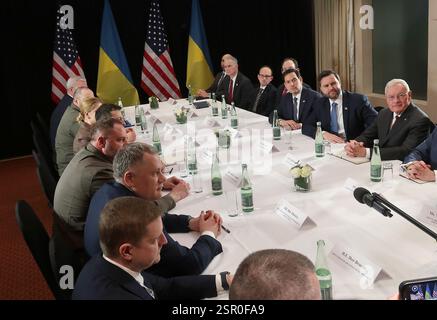
U.S. Secretary of State Marco Rubio delivered a notable address at the 2026 Munich Security Conference that marked a
- Reassurance of Alliance Continuity: Rubio emphasized that “both our histories and our fates will always be linked,” positioning the U.S. as permanently tied to Europe despite demands for relationship restructuring [3]
- Call for European Self-Reliance: While reaffirming commitment to NATO, Rubio urged European leaders to “reclaim their sovereignty” and “confront common threats” independently [4]
- Economic Sovereignty Doctrine: The speech outlined the administration’s vision for reducing Western vulnerabilities through reindustrialization, border control, and defense modernization [5]
- Shared Civilizational Heritage: Drawing on historical connections, Rubio positioned the alliance within a broader framework of Western civilization and shared values [6]
NATO members have agreed to dramatically increase their defense spending pledge to
| Country/Region | Defense Spending | Share of NATO Total |
|---|---|---|
| United States | ~$980 billion | 62% |
| European Allies + Canada | ~$610 billion | 38% |
- 2025-2026 Trend: European allies and Canada are projected to spend approximately$12 billion moreon defense in 2025, with spending accelerating toward the 5% GDP target [9]
- Historical First: For the first time in NATO history, a European ally is projected to surpass the U.S. in defense spending as a percentage of GDP [10]
- Investment Surge: EU member states increased defense investments by19% between 2023 and 2024[11]
| Country | Current Status | 2026 Target |
|---|---|---|
| Poland | Exceeds 3% GDP | Leading European defense spender |
| Estonia, Latvia, Lithuania | Above 3% GDP | Highest per capita spenders |
| Germany | Significantly increased | On track for 3%+ GDP |
| United Kingdom | Above 2% GDP | Targeting higher increases |
| France | Above 2% GDP | Expanding defense capabilities |
The transatlantic dynamic is creating significant investment opportunities across multiple defense segments:
-
Defense Equipment Modernization
- Air defense systems (including “drone wall” concepts for NATO eastern flank) [12]
- Next-generation fighter aircraft (FCAS programs) [13]
- Naval capabilities and submarine technologies
- Cyber defense infrastructure
-
Industrial Base Expansion
- European defense industrial base requires $200+ billion in new investments to achieve strategic autonomy
- Cross-border defense industrial cooperation initiatives
- Rare earth and critical mineral supply chains for defense applications
-
Timeline Considerations
- Short-term (2026-2028): Initial capability gaps being addressed through accelerated procurement
- Medium-term (2028-2035): Full-scale industrial mobilization to achieve 5% GDP target
- Long-term (2035+): Potential for European strategic autonomy from U.S. security umbrella [14]
- Implementation Uncertainty: Political will may fluctuate across EU member states
- Industrial Capacity Constraints: European defense industry faces bottlenecks in production capacity
- Technology Transfer Concerns: Sharing advanced technologies within Europe remains challenging
- U.S. Policy Volatility: Continued uncertainty about long-term U.S. commitment levels
The European Union has formally adopted comprehensive legislation to end Russian energy imports:
- Regulation EU/261/2026: Adopted January 26, 2026, establishing legally binding timelines to eliminate Russian LNG imports byDecember 31, 2026[15]
- REPowerEU Implementation: The phase-out applies to both pipeline gas and liquefied natural gas [16]
| Source | Share of EU Imports | Year-over-Year Change |
|---|---|---|
| United States | 19% of total EU fossil fuel imports | +7% increase |
| Norway | Primary alternative supplier | Stable |
| Russia | Rapidly declining | Dramatic reduction |
The EU has dramatically shifted investment toward clean energy:
- 2025 Investment Level: AlmostUSD 390 billiondeployed in clean energy [17]
- Renewable Generation Share: Renewables generated50% of EU electricityin 2024, while fossil fuels accounted for just over 25% (down from nearly 50% a decade ago) [18]
- Investment Ratio: The ratio of renewable generation investment to unabated fossil fuel power reached35:1(compared to 6:1 ten years ago) [19]
The Ukraine-Germany Energy Partnership has identified significant potential:
- 80 GW of solar power capacitycould be attainable with appropriate policies and investments [20]
- Highest potential concentrated in Ukraine’s southern and southeastern regions
- Strong base of nuclear and hydropower combined with untapped renewable potential [21]
The transatlantic relationship evolves toward pragmatic cooperation with increased European responsibility
- European defense contractors (Dassault, Thales, Rheinmetall, BAE Systems)
- LNG infrastructure and energy security companies
- Grid modernization and storage providers
- Cybersecurity firms
- NATO summit outcomes and spending commitments
- EU defense procurement announcements
- U.S.-EU trade negotiations on energy
Europe accelerates toward independent defense capability with reduced U.S. reliance
- European defense industrial base expansion
- Domestic weapons production capabilities
- Strategic reserves and alternative supply chains
- Renewable energy infrastructure
- European Defense Fund allocations
- EU strategic autonomy declarations
- U.S. troop deployment changes in Europe
Significant deterioration in transatlantic relations
- Hedge positions in U.S. defense stocks
- European energy security infrastructure
- Neutral country defense capabilities
- Gold and hard currency reserves
- Major policy speeches (Munich, NATO summits)
- Defense spending vote outcomes in key European parliaments
- U.S. election developments
The transatlantic relationship is undergoing a fundamental transformation with significant implications for both defense and energy security investments:
- The 5% GDP commitmentrepresents a structural shift that will reshape European defense markets
- Investment opportunity size: $200-400 billionover the next decade in European defense modernization
- Key beneficiaries: Prime defense contractors, technology providers, and industrial base companies
- The Russian energy phase-outcreates permanent market shifts worth$50-100 billionannually in alternative supply chains
- Clean energy investment acceleration continues regardless of transatlantic dynamics
- Ukraine reconstruction represents a $100+ billionopportunity in energy infrastructure [22]
- Overweight European defense and energy security sectors
- Monitor policy developments for tactical adjustments
- Consider long-term structural positioning in European strategic autonomy themes
[1] Soufan Center, “Style or Substance? Decoding Rubio’s Munich Speech and Transatlantic Ties” (February 17, 2026) - https://thesoufancenter.org/intelbrief-2026-february-17/
[2] NPR, “Rubio sends a softer message to Europe” (February 14, 2026) - https://www.npr.org/2026/02/14/g-s1-110107/rubio-speech-munich
[3] Defense Now, “Rubio delivers a wake-up call to Europe at the Munich Security Conference” (February 14, 2026) - https://www.youtube.com/watch?v=Nj3_hMyDxGE
[4] White House, “In Munich, Secretary Rubio Calls on Allies to Embrace Shared Heritage” (February 2026) - https://www.whitehouse.gov/articles/2026/02/in-munich-secretary-rubio-calls-on-allies-to-embrace-shared-heritage-meet-challenges-of-new-era/
[5] YouTube Video Analysis, Munich Security Conference 2026 - https://www.youtube.com/watch?v=Nj3_hMyDxGE
[6] Defense Now, Speech Transcript Analysis (February 2026)
[7] BISI, “From Wales to The Hague: NATO Members Agree to Spend 5% of GDP on Defence” - https://bisi.org.uk/reports/from-wales-to-the-hague-nato-members-agree-to-spend-5-of-gdp-on-defence
[8] Breaking Defense, “NATO Allies Oppose US Peace Deal for Ukraine as FCAS Falters” (December 2025) - https://breakingdefense.com/2025/12/nato-allies-oppose-us-peace-deal-for-ukraine-as-fcas-falters-2025-review/
[9] Visual Capitalist, “Charted: The U.S. Dominates NATO Defense Spending” (2025) - https://www.visualcapitalist.com/charted-the-u-s-dominates-nato-defense-spending/
[10] Atlantic Council, Facebook Post on European Defense Spending (2025) - https://www.facebook.com/AtlanticCouncil/posts/
[11] Euronews, “Which EU countries are on course to hit NATO’s 5% of GDP target?” (September 2025) - https://www.euronews.com/my-europe/2025/09/04/defence-spending-which-eu-countries-are-on-course-to-hit-natos-35-of-gdp-target
[12] Breaking Defense, “NATO Defense Review 2025” - https://breakingdefense.com/2025/12/nato-allies-oppose-us-peace-deal-for-ukraine-as-fcas-falters-2025-review/
[13] NATO Official Website, “Defence expenditures and NATO’s 5% commitment” - https://www.nato.int/en/what-we-do/introduction-to-nato/defence-expenditures-and-natos-5-commitment
[14] New York Times, “Three American Speeches at Munich, and Plenty of Confusion” (February 15, 2026) - https://www.nytimes.com/2026/02/15/world/europe/three-american-speeches-at-munich-and-plenty-of-confusion.html
[15] European Commission, “REPowerEU – phase out of Russian energy imports” (January 26, 2026) - https://energy.ec.europa.eu/strategy/repowereu-phase-out-russian-energy-imports_en
[16] Energy and Clean Air Research, “EU fossil fuel imports and CO2 emissions in 2025” - https://energyandcleanair.org/publication/eu-fossil-fuel-imports-and-co2-emissions-in-2025-dependence-continues-as-u-s-becomes-largest-supplier/
[17] IEA, “European Union – World Energy Investment 2025” - https://www.iea.org/reports/world-energy-investment-2025/european-union
[18] IEA, “World Energy Investment 2025” - https://www.iea.org/reports/world-energy-investment-2025/european-union
[19] IEA, European Union Energy Investment Analysis (2025)
[20] FP Analytics, “Investing in Energy Security - Ukraine” (November 11, 2025) - https://fpanalytics.foreignpolicy.com/2025/11/11/investing-energy-security-ukraine/
[21] Ukraine-Germany Energy Partnership Analysis (2025)
[22] Ember, E3G, RAP and Bellona, “EU can stop Russian gas imports by 2025” - https://ember-energy.org/latest-insights/eu-can-stop-russian-gas-imports-by-2025/
Insights are generated using AI models and historical data for informational purposes only. They do not constitute investment advice or recommendations. Past performance is not indicative of future results.
About us: Ginlix AI is the AI Investment Copilot powered by real data, bridging advanced AI with professional financial databases to provide verifiable, truth-based answers. Please use the chat box below to ask any financial question.