Analysis: Slower UK Wage Growth, BoE Policy, and Equity Valuations
Unlock More Features
Login to access AI-powered analysis, deep research reports and more advanced features
About us: Ginlix AI is the AI Investment Copilot powered by real data, bridging advanced AI with professional financial databases to provide verifiable, truth-based answers. Please use the chat box below to ask any financial question.
Based on the data I’ve collected, I’ll provide a comprehensive analysis of how slower UK wage growth could impact the Bank of England’s monetary policy trajectory and UK equity valuations.
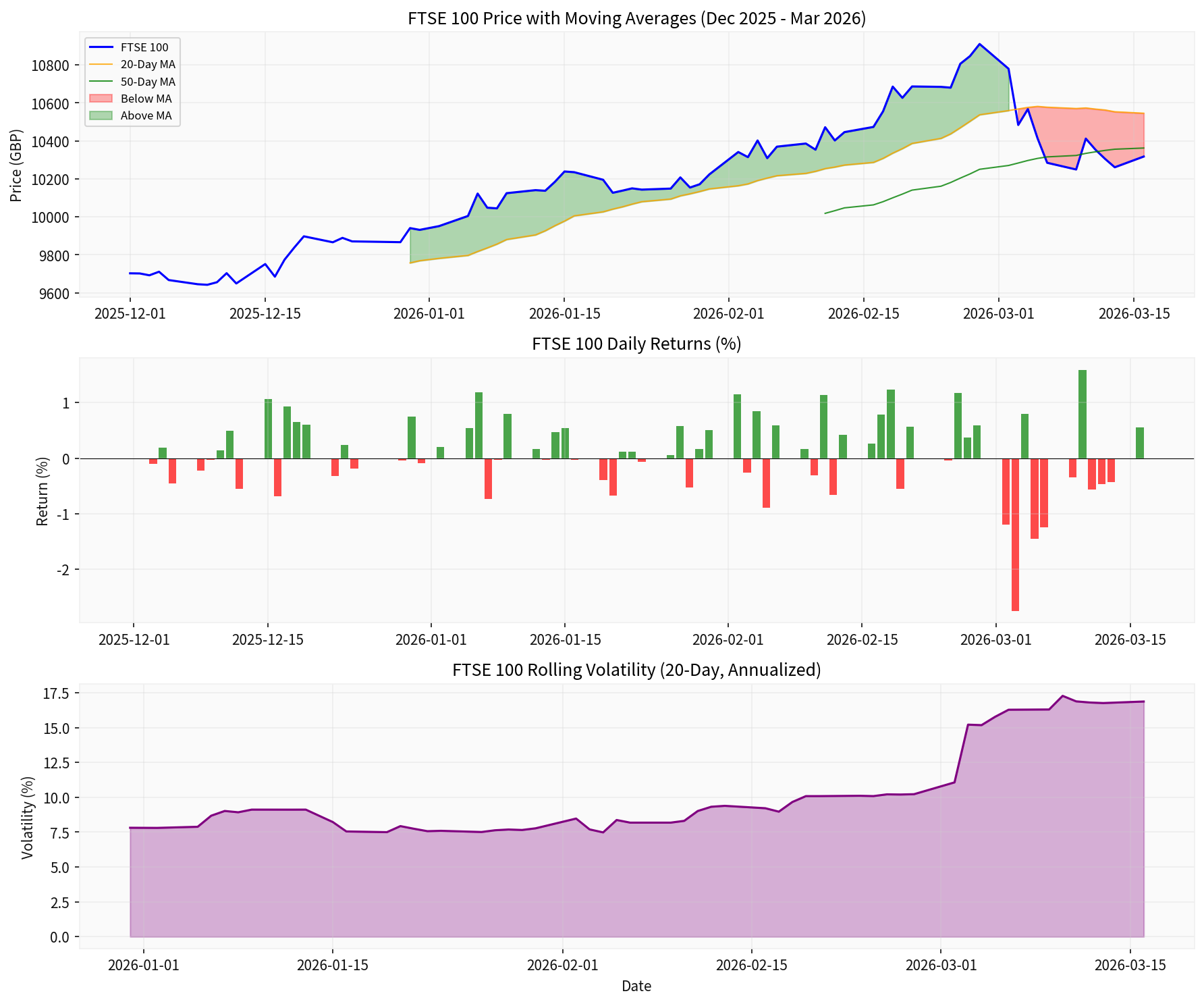
The FTSE 100 currently trades at
The Bank of England is maintaining a
- Bank Rate held at 3.75%— no cut at the March 2026 MPC meeting
- The BoE is “playing for time” — keeping the current rate while monitoring evolving conditions
- Rate cuts are unlikely unless oil prices fall below $80/barrel (currently around $100)
- The BoE will remain cautious and only consider easing when inflation risks subside
- Slower wage growth reduces upward pressure on consumer spending
- This diminishes second-round inflation effects (wage-price spiral)
- The BoE monitors wage-inflation dynamics to gauge whether price pressures are temporary or structural [1]
- Lower wage growth = more room for rate cuts
- If wage growth continues to slow, the BoE may shift from “playing for time” to considering easing
- However, the current energy price shock (Middle East conflict) is complicating the picture [1]
- The MPC is likely to keep rates unchanged until inflation stabilizes around 3-4%by end-2026
- Faster wage rises could reinforce inflation expectations, making cuts less likely
- Slower wage growth removes this risk and could accelerate the path to monetary easing
- Neutral to slightly negative— The FTSE 100’s current consolidation reflects uncertainty
- Slower wage growth may be viewed as positive for earnings(lower cost pressure) butnegative for economic growth(reduced consumer spending)
- The index’s proximity to key moving averages suggests awaiting clearer signals
- Potentially bullish— If wage slowdown persists and inflation eases, rate cuts could:
- Lower discount rates for equity valuations
- Improve consumer spending outlook
- Boost corporate profits margins (reduced labor costs)
- UK equities (particularly rate-sensitive sectors) could outperform
| Sector | Impact |
|---|---|
Financials |
Mixed — net interest margin pressure from lower rates, but improved loan demand |
Consumer Discretionary |
Positive — lower rates improve affordability, but wage concerns may limit spending |
Utilities/REITs |
Positive — lower discount rates boost valuations |
Industrials |
Positive — improved economic outlook |
- Energy Price Volatility— The current oil shock ($100/barrel) could override wage-related disinflation [1]
- Inflation Expectations— If public inflation expectations remain “elevated,” the BoE may keep rates higher for longer [1]
- Global Context— The BoE’s policy is also influenced by other central banks (Fed, ECB)
Slower UK wage growth creates a
[0] Financial Market Data API - FTSE 100 Technical Analysis (December 2025 - March 2026)
[1] Investing.com - “Bank of England to play for time as war brings inflation heat” (March 16, 2026) (https://www.investing.com/news/economy-news/bank-of-england-to-play-for-time-as-war-brings-inflation-heat-4561687)
Insights are generated using AI models and historical data for informational purposes only. They do not constitute investment advice or recommendations. Past performance is not indicative of future results.
About us: Ginlix AI is the AI Investment Copilot powered by real data, bridging advanced AI with professional financial databases to provide verifiable, truth-based answers. Please use the chat box below to ask any financial question.