Fed Rate Decision and Market Outlook: March 18, 2026
Unlock More Features
Login to access AI-powered analysis, deep research reports and more advanced features
About us: Ginlix AI is the AI Investment Copilot powered by real data, bridging advanced AI with professional financial databases to provide verifiable, truth-based answers. Please use the chat box below to ask any financial question.
Related Stocks
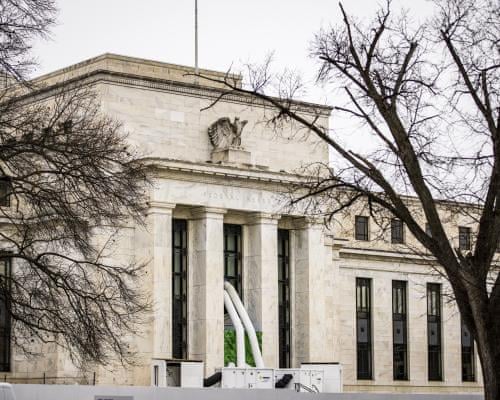
The Federal Open Market Committee (FOMC) convenes amid heightened economic uncertainty, with the decision concluding on March 18, 2026. Market participants overwhelmingly expect the Fed to maintain the benchmark interest rate in the current range of 3.5%-3.75%, with CME FedWatch indicating a 98% probability of no change [1][2]. This consensus reflects the complex interplay of competing economic forces confronting policymakers.
Several factors complicate the Fed’s calculus. Employment data revealed unexpected job cuts of 92,000 positions in February, marking a significant deterioration in labor market conditions [1]. Simultaneously, the Personal Consumption Expenditures (PCE) Price Index—the Fed’s preferred inflation measure—has risen to its highest level since March 2024, indicating persistent inflationary pressures [4]. The geopolitical dimension adds further uncertainty, as US-Iran tensions present added economic risk amid ongoing Middle East instability [1][2][3].
The bond market is sending mixed signals about monetary policy trajectory. Two-year Treasury yields have risen to 3.75%, trading above the effective fed funds rate (3.64%) for the first time in roughly three years—a development that suggests markets perceive elevated policy tightening risks [5]. The 30-year Treasury yield is approaching 5%, reflecting broader concerns about fiscal sustainability and inflation persistence [5].
Forward guidance expectations indicate the Fed may modestly revise upward economic growth and inflation forecasts. Core PCE inflation projections could be adjusted from 3.0% to 3.2%-3.3%, while unemployment forecasts may increase from 4.5% to higher levels [5]. These revisions would acknowledge the challenging environment facing the economy as it navigates geopolitical headwinds and inflationary pressures.
Market performance over the past ten trading sessions has been characterized by muted price action despite significant headline risks—a pattern analysts describe as a “Seelman-style loop” reflecting relative calm amid substantial uncertainty [0]. The major indices closed on March 17 with the S&P 500 at 6,716.08, NASDAQ at 22,479.53, and Dow Jones at 46,993.27, while the Russell 2000 showed recent resilience at 2,519.99 [0].
Sector performance on March 17 revealed pronounced rotation dynamics. Industrials led with a 1.63% gain, followed by Energy at 1.12% and Consumer Cyclical at 0.88% [0]. Technology posted modest gains of 0.33%, while Financial Services rose 0.20% [0]. Conversely, Utilities declined 0.23%, Healthcare fell 0.68%, Basic Materials dropped 0.71%, Real Estate declined 0.82%, and Consumer Defensive recorded the weakest performance at -1.06% [0].
This sector divergence reflects several interconnected dynamics. Energy stocks are benefiting directly from the 70% year-to-date surge in WTI crude oil prices, which have climbed from under $60 to approximately $105 per barrel [4]. The Strait of Hormuz is operating at near-total standstill due to geopolitical tensions, further supporting energy prices [4]. Exxon Mobil (XOM) reached a 52-week high at $158.84, reflecting investor confidence in the energy sector’s outlook [0].
The rotation away from defensive sectors suggests improving risk appetite, though the magnitude remains moderate. Consumer Defensive’s weakness despite persistent inflation concerns indicates that valuations in that sector may have peaked, prompting investors to seek returns elsewhere [4]. The slight improvement in market breadth—with all 11 S&P 500 sectors posting gains on March 16—suggests the market may be broadening beyond mega-cap concentration [3].
The technology sector continues to be shaped by massive AI infrastructure investment. The five largest hyperscalers are projected to spend over $700 billion on AI infrastructure in 2026, sustaining the investment theme that has driven significant sector performance [3]. This spending boom positions select technology companies to benefit from continued enterprise and cloud AI adoption.
Individual stock performance reflects mixed sentiment. NVIDIA (NVDA) traded at $181.93, down 0.70% on March 17, with a forward price-to-earnings ratio of 22x—reflecting elevated but not extreme valuation relative to growth prospects [0]. Apple (AAPL) rose 0.56% to $254.23, maintaining a P/E ratio of 32.14 [0]. Broadcom raised its AI networking revenue target to $3.25 billion from a previous $2.75 billion, reflecting strong demand for AI-related networking infrastructure [3].
The Magnificent Seven stocks have shown weakness recently, with concerns that earnings growth of 60% since 2021 may be plateauing [4]. Market observers anticipate continued rotation toward the remaining 493 S&P 500 stocks as mega-cap growth faces increasing scrutiny regarding valuation sustainability [4]. The Morningstar Global Next Generation AI Index returned 44.06% for the twelve months ending March 10, 2026, demonstrating the sector’s strong performance but also raising questions about future upside potential [3].
The relationship between bond yields and stock valuations remains critical to market dynamics. Higher Treasury yields create headwinds for growth stock valuations by increasing discount rates applied to future earnings. The recent rise in two-year yields above the fed funds rate suggests markets are pricing in a more restrictive monetary policy stance for an extended period [5].
The bond market is experiencing what analysts describe as “unanchored” behavior, with geopolitical impacts creating uncertainty about appropriate yield levels [5]. Stagflationary impulses are broadening beyond the energy sector, as higher oil prices filter through the economy while economic growth slows [5]. This environment challenges the equity market’s ability to sustain valuations, particularly in rate-sensitive sectors.
Fed policy implications extend beyond immediate rate decisions. The inflation data, even before considering recent geopolitical developments, painted a mixed picture that complicates the path toward policy normalization [5]. Investors must weigh the potential for sustained higher rates against the economic damage that restrictive monetary policy may inflict.
The healthcare sector posted a 0.68% decline on March 17, underperforming the broader market [0]. However, individual names show differentiated performance. UnitedHealth (UNH) rose 0.73% to $287.57, suggesting recovery potential following challenging periods [0]. Tenet Healthcare has recorded 10.3% year-to-date growth, outperforming the broader sector [3].
Long-term attractiveness remains for patient healthcare investors, as many sector-specific concerns appear priced into current valuations [3]. UnitedHealth is expected to rebound in 2026 after a challenging period, potentially presenting opportunities for contrarian investors [3]. Healthcare reform news could move pharmaceutical stock prices, adding near-term volatility but potentially creating entry points for longer-term positions.
-
Geopolitical Escalation: Further Middle East conflict could disrupt oil supplies significantly, driving headline inflation higher and complicating Fed policy [1][2][3]. The Strait of Hormuz at near-total standstill represents a critical chokepoint [4].
-
Inflation Persistence: Oil-driven inflation could prove sticky, forcing the Fed to maintain restrictive policy longer than markets anticipate. Core PCE revisions upward to 3.2%-3.3% reflect this concern [5].
-
Labor Market Weakness: The 92,000 February job cuts could signal broader economic slowing, potentially impacting corporate earnings across sectors [1].
-
Valuation Compression: Technology and growth stocks remain elevated, creating vulnerability to earnings disappointments or policy surprises.
-
Policy Uncertainty: Questions surrounding Fed leadership amid ongoing investigations add another layer of uncertainty to policy trajectory [4].
-
Energy Sector Momentum: Oil prices up 70% year-to-date have driven significant energy stock performance, with Exxon Mobil hitting 52-week highs [0][4]. Enterprise Products Partners and Enbridge offer ways to access energy exposure without direct oil price volatility [4].
-
Small Cap Revival: The Russell 2000 showing recent resilience suggests potential for small-cap comeback as market breadth improves [0].
-
Dividend Growth Stocks: Value and dividend growth stocks deserve attention in volatile markets, offering income and relative stability [4].
-
Healthcare Recovery: Select healthcare names showing recovery potential, particularly UnitedHealth following its challenging period [3].
-
Sector-Specific ETFs: Diversification through sector-specific ETFs provides risk management while maintaining market participation.
The Federal Reserve is expected to hold interest rates steady at 3.5%-3.75% at its March 18-19 meeting, with markets pricing a 98% probability of no change [1][2]. Key economic indicators present mixed signals: February job cuts of 92,000 positions indicate labor market weakness, while PCE inflation has risen to its highest level since March 2024 [1][4]. Geopolitical tensions—particularly US-Iran conflict—have driven oil prices up 70% year-to-date to approximately $105 per barrel, creating stagflationary pressures [4].
Sector rotation continues favoring value and energy, with Industrials (+1.63%) and Energy (+1.12%) leading March 17 performance [0]. Technology (+0.33%) shows mixed results, while defensive sectors lag—Consumer Defensive declined 1.06% [0]. The $700 billion AI infrastructure spending forecast for 2026 underscores continued technology sector transformation, though mega-cap valuations face increasing scrutiny [3].
Bond yields remain elevated, with the 2-year Treasury at 3.75% (above fed funds rate) and 30-year Treasury approaching 5% [5]. This environment suggests continued pressure on growth stock valuations while favoring value-oriented investments. Market breadth has shown recent improvement, with all 11 S&P 500 sectors posting gains on March 16 [3].
Investors should monitor weekly jobless claims, oil inventory reports, Fed Chair Powell’s post-meeting commentary, and upcoming Q1 2026 earnings reports for signals about market direction. The current environment favors diversification through sector-specific ETFs and disciplined attention to valuations across growth and value segments.
Insights are generated using AI models and historical data for informational purposes only. They do not constitute investment advice or recommendations. Past performance is not indicative of future results.
About us: Ginlix AI is the AI Investment Copilot powered by real data, bridging advanced AI with professional financial databases to provide verifiable, truth-based answers. Please use the chat box below to ask any financial question.