Jim Cramer's Nvidia Recommendation Amid Market Turmoil: March 18, 2026 Analysis
Unlock More Features
Login to access AI-powered analysis, deep research reports and more advanced features
About us: Ginlix AI is the AI Investment Copilot powered by real data, bridging advanced AI with professional financial databases to provide verifiable, truth-based answers. Please use the chat box below to ask any financial question.
Related Stocks
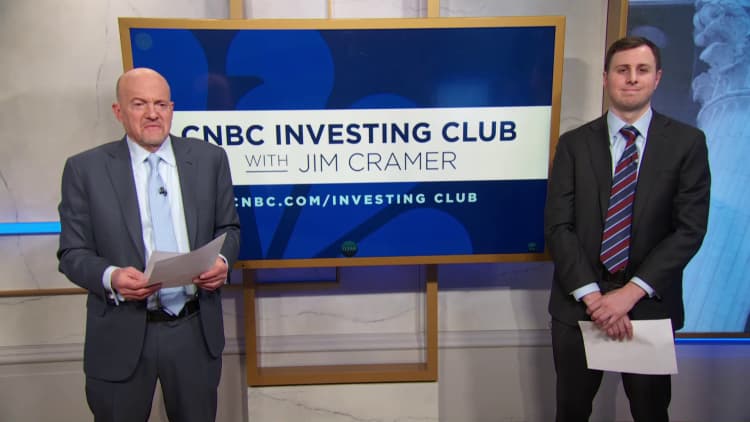
On March 18, 2026, a challenging market day characterized by significant declines across major indices saw CNBC’s Jim Cramer recommend Nvidia (NVDA) as a stock investors could still consider buying [1]. The market experienced substantial turbulence driven by soaring oil prices resulting from the U.S.-Israel attack on Iran on February 28, 2026, hot February wholesale inflation data, and the Federal Reserve’s decision to hold interest rates steady without offering reassurance about potential rate cuts [1].
The Dow Jones Industrial Average closed down 1.47% (750+ points) at its 2026 closing low, while the S&P 500 declined 1.08% and the NASDAQ fell 1.20% [0][1]. The Russell 2000 also dropped 1.30%, indicating broad-based market weakness [0]. Sector performance revealed Utilities (+1.21%) and Energy (+0.34%) as the only gainers, while Consumer Cyclical (-1.36%) and Consumer Defensive (-1.26%) led declines [0]. The Technology sector, where Nvidia operates, declined 1.01% on the day [0].
Despite the broader market decline, NVDA demonstrated relative resilience, falling 0.84% ($1.53) to close at $180.40, compared to the NASDAQ’s 1.20% decline [0]. The stock traded within a day range of $180.35 to $183.38, with a 52-week range of $86.62 to $212.19 [0]. Key fundamental metrics include a market capitalization of $4.38 trillion, a trailing P/E ratio of 36.89x, and EPS (TTM) of $4.89 [0]. Trading volume reached 154.38 million shares, below the average of 175.93 million [0].
Jim Cramer’s recommendation centered on several key arguments [1]. First, he characterized Nvidia as “unlinked” from current macro stressors, including Iran war concerns and stagflation fears [1]. Second, he positioned NVDA as “one of the fastest growing firms with one of the lowest valuations” in the market [1]. Third, he highlighted that the stock trades at approximately 12x 2027 estimated EPS compared to the S&P 500’s 18x multiple, suggesting significant valuation compression potential [1]. However, Cramer tempered his enthusiasm by advising investors to buy “some but not a lot” due to ongoing macro uncertainty [1].
The ongoing GTC (GPU Technology Conference) represents a significant near-term catalyst for Nvidia [1]. Expected announcements include a new inference chip development and details regarding $1 trillion in expected Blackwell and Vera Rubin orders through 2027 [1]. Additional recent developments include Nvidia launching an AI platform for hospital operating rooms, representing expansion into healthcare robotics [2]. However, the company has faced some consumer sentiment challenges, with DLSS 5 generating controversy and gamer backlash [3].
While Cramer’s characterization of NVDA as “low valuation” may appear counterintuitive given the current trailing P/E of 36.89x [0], his reference to 12x 2027 estimated EPS suggests substantial earnings growth expectations that would compress the forward valuation significantly. Historical context shows NVDA has risen 53% over the past year and 94% since April 2025 [5], with Cramer previously predicting the stock could reach an all-time high in January 2025 [5].
- Macro Uncertainty Risk: Higher oil prices and persistent inflation could delay Fed rate cuts, potentially pressuring growth stocks like NVDA [1]
- Valuation Risk: Despite Cramer’s forward P/E argument, the current trailing P/E of 36.89x remains elevated compared to historical averages [0]
- Execution Risk: The $1 trillion order pipeline through 2027 represents forward-looking expectations that may not fully materialize [1]
- Market Sentiment Risk: When Cramer recommends stocks as “defensive” buys during market stress, it signals significant market weakness that could continue
- GTC Expectation Risk: If announcements fail to meet elevated expectations, the stock could experience negative reaction
- Relative Strength: NVDA’s 0.84% decline outperformed the NASDAQ’s 1.20% drop, suggesting relative strength that could accelerate in a recovery [0]
- Valuation Gap: The disparity between current P/E (36.89x) and Cramer’s 2027 forward estimate (12x) represents significant upside if growth materializes [1]
- AI Infrastructure Demand: Continued robust demand for AI infrastructure remains a fundamental tailwind [1]
- Diversification into Healthcare: New initiatives in hospital AI [2] represent potential new revenue streams
This analysis is based on the CNBC report [1] published on March 18, 2026, which documented Jim Cramer’s recommendation of Nvidia stock during a challenging market day. The market experienced significant declines across all major indices, with the Dow falling to its 2026 closing low, driven by oil price spikes and hot inflation data [1]. Despite the broader market weakness, Cramer identified NVDA as relatively insulated from macro stressors and positioned it as attractively valued relative to expected 2027 earnings [1].
Current market data shows NVDA trading at $180.40 with a market cap of $4.38 trillion [0]. The stock has demonstrated relative resilience, outperforming the NASDAQ on the challenging trading day [0]. Key catalysts including the GTC conference and potential announcements about new inference chips and a $1 trillion order pipeline through 2027 provide near-term catalysts [1].
Investors should note that while Cramer’s recommendation is notable, his advice to buy “some but not a lot” reflects the significant macro uncertainty remaining in the market [1]. The discrepancy between the elevated trailing P/E (36.89x) and the forward 2027 estimate (12x) cited by Cramer represents both the opportunity and the risk in this recommendation—it assumes substantial earnings growth that may or may not materialize as expected [0][1].
Insights are generated using AI models and historical data for informational purposes only. They do not constitute investment advice or recommendations. Past performance is not indicative of future results.
About us: Ginlix AI is the AI Investment Copilot powered by real data, bridging advanced AI with professional financial databases to provide verifiable, truth-based answers. Please use the chat box below to ask any financial question.