European Markets Slump as Iran War Escalates with Energy Infrastructure Attacks
Unlock More Features
Login to access AI-powered analysis, deep research reports and more advanced features
About us: Ginlix AI is the AI Investment Copilot powered by real data, bridging advanced AI with professional financial databases to provide verifiable, truth-based answers. Please use the chat box below to ask any financial question.
Related Stocks
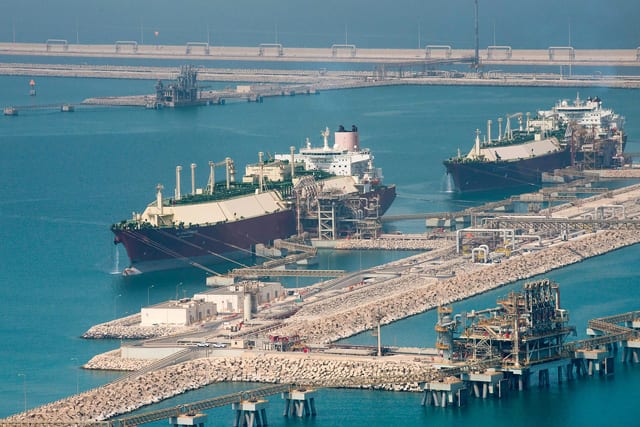
The March 18, 2026 attacks on energy infrastructure represent a significant escalation in the Iran-Israel conflict, with strategic implications extending far beyond the immediate military dimension. Israel targeted Iran’s South Pars gas field—the world’s largest natural gas field—while Iran responded by striking Qatar’s Ras Laffan LNG facility, a critical node in global energy supply chains [1][2][3].
The dual targeting of energy infrastructure marks a deliberate shift in warfare strategy, with Iran explicitly targeting Gulf neighbor facilities to drive up global oil prices and create economic pressure on nations supporting Israel. This represents a notable expansion of the conflict beyond direct adversaries, potentially drawing additional nations into the geopolitical fray.
The market reaction reflects immediate supply concerns, with oil prices spiking sharply. Brent crude’s 4.5% rise to $112.19 per barrel signals significant supply risk premium, while the substantial expected decline in UK markets (~9%) suggests particularly acute concern about the potential for further escalation affecting European energy security [1].
Central banks face renewed policy complications. The European Central Bank, Bank of England, Swedish Riksbank, and Swiss National Bank were already expected to hold rates, but sustained elevated energy prices could complicate their inflation targeting frameworks, potentially delaying monetary easing that markets had anticipated [1].
-
Energy Supply Disruption: Qatar’s Ras Laffan LNG facility sustained extensive damage, potentially tightening global gas markets significantly. Extended disruption could affect European and Asian energy supplies simultaneously [2][3].
-
Regional Escalation: Iran’s strategy of targeting Gulf neighbors’ energy infrastructure may expand to other nations, potentially including Saudi Arabia, UAE, or other petroleum exporters, further destabilizing global energy markets [2][3].
-
Inflation Pressure: Extended elevated oil/gas prices could trigger a new wave of global inflation, complicating central bank policy and potentially reversing recent disinflation trends [3].
-
Market Volatility: UK markets (FTSE) showing extreme weakness (~9% drop) suggests significant risk-off sentiment that could spread to other global markets, with elevated volatility likely persisting until conflict de-escalates [1].
-
Shipping Disruption Risk: Further escalation could threaten Strait of Hormuz transit, through which approximately 20% of global oil supply passes, creating catastrophic supply disruption scenarios.
-
Energy Sector Momentum: Energy companies may benefit from elevated commodity prices in the near term, though this is contingent on conflict not expanding to threaten production facilities elsewhere.
-
Defensive Positioning: Companies with strong balance sheets and diversified operations may present relative value as risk-off sentiment creates indiscriminate selling.
-
Volatility Trading: Elevated market volatility creates opportunities for volatility-based strategies and hedging instruments.
This analysis synthesizes confirmed market data and reported developments from the Iran-Israel conflict escalation:
- Brent crude: +4.5% to $112.19/barrel [1]
- WTI crude: +1.0% to $97.32/barrel [1]
- UK FTSE expected opening: ~9% decline [1]
- German DAX expected opening: -1.6% [1]
- French CAC 40 expected opening: -1.0% [1]
- Italian FTSE MIB expected opening: -1.2% [1]
- Israel struck Iran’s South Pars gas field (world’s largest) on March 18, 2026 [2][3]
- Iran retaliated with missile attacks on Qatar’s Ras Laffan LNG terminal [1][2][3]
- U.S. President Trump issued warning about further escalation [1]
- Specific casualty figures from the attacks
- Extent of production disruption timelines
- Whether additional Gulf nations will be targeted
- Actual extent of damage to Ras Laffan facility
The situation remains highly fluid, with potential for rapid further developments. Market participants should monitor for additional attacks, statements from involved parties, and central bank responses to evolving economic conditions.
Insights are generated using AI models and historical data for informational purposes only. They do not constitute investment advice or recommendations. Past performance is not indicative of future results.
About us: Ginlix AI is the AI Investment Copilot powered by real data, bridging advanced AI with professional financial databases to provide verifiable, truth-based answers. Please use the chat box below to ask any financial question.