Oil Surges Past $110 as Middle East Escalation Triggers Market Selloff
Unlock More Features
Login to access AI-powered analysis, deep research reports and more advanced features
About us: Ginlix AI is the AI Investment Copilot powered by real data, bridging advanced AI with professional financial databases to provide verifiable, truth-based answers. Please use the chat box below to ask any financial question.
Related Stocks
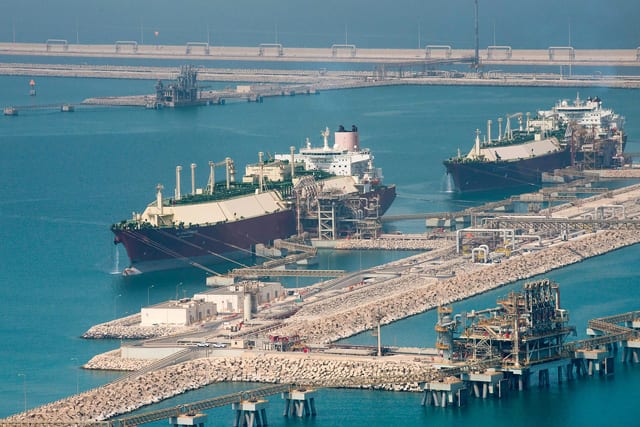
The current market turbulence stems from a significant geopolitical escalation in the Middle East that has pushed Brent crude oil prices above $110 per barrel—the highest level since the pandemic recovery. On Wednesday, March 18, 2026, Israel struck Iran’s South Pars gas field, which is the world’s largest gas field. Iran responded by attacking Qatar’s Ras Laffan LNG facility, which accounts for approximately 20% of global LNG supply [2][3].
This escalation has triggered a broad market selloff, with all major U.S. indices experiencing significant declines. The Dow Jones Industrial Average dropped 1.47% to close at 46,225.16, the S&P 500 fell 1.08% to 6,624.71, the NASDAQ declined 1.20% to 22,152.42, and the Russell 2000 slipped 1.30% to 2,478.64 [0]. The Federal Reserve responded by holding interest rates steady and raising its inflation forecast, signaling concern about the potential economic impact of elevated energy prices [2].
Market expectations have shifted dramatically, with traders now pricing in less than a 50% probability of a Federal Reserve rate cut by the end of 2026 (49%) [2]. This represents a meaningful change from previous expectations and creates additional headwinds for risk assets. Asian markets dropped sharply on Thursday, with European markets poised to follow the U.S. selloff [5].
The convergence of geopolitical risk and monetary policy constraints creates a particularly challenging environment for investors. The Middle East conflict now directly threatens global energy infrastructure, with the Strait of Hormuz representing a critical chokepoint for oil shipments. President Trump has stated willingness to deploy U.S. troops, potentially escalating American involvement in the conflict [3].
The Fed’s position is now complicated by two competing pressures: inflation concerns stemming from higher oil prices and the economic drag that elevated energy costs create. This “higher for longer” interest rate environment could persist longer than markets had anticipated, particularly if oil prices remain elevated or increase further.
The energy sector presents a complex dynamic—while oil producers may benefit from higher prices, the broader market faces margin pressure from increased input costs. Airlines and industrials are particularly vulnerable to sustained energy price increases, while the technology sector may see relative outperformance in a risk-off environment.
- Inflation Reacceleration: Oil at $110+ could reignite inflation pressures, potentially limiting the Fed’s capacity to ease monetary policy [2]
- Fed Policy Constraint: Less than 50% probability of rate cuts by year-end creates structural headwinds for equity valuations
- Geopolitical Escalation Premium: Further escalation could push oil significantly higher, amplifying market stress
- Energy Supply Disruption: Threats to Strait of Hormuz pose significant global energy supply risk [3]
- Sector-Specific Pressure: Airlines face margin compression; industrials see input cost inflation
- Energy Sector Volatility: Oil producers may benefit from elevated prices, though volatility is expected to remain high
- Flight-to-Safety Assets: Gold and Treasury securities may attract flows amid uncertainty
- Defensive Positioning: Utilities and consumer staples historically perform relatively well during periods of elevated volatility
- Short-Term Oversold Conditions: Technical rebounds may occur following significant one-day selloffs
The market is responding to a perfect storm of geopolitical and monetary policy factors. Oil prices surging past $110 per barrel due to Middle East conflict escalation has triggered a broad selloff across U.S. indices, with the Dow experiencing its most significant decline in recent trading sessions [0][1]. The Federal Reserve’s decision to hold rates steady while raising inflation forecasts signals concern about the economic ripple effects of elevated energy costs [2].
Qatar’s Ras Laffan LNG facility, which handles approximately 20% of global LNG supply, was targeted in Iran’s retaliation, creating potential for sustained energy supply disruptions [3]. The conflict now directly impacts critical global energy infrastructure, moving beyond regional tensions to global economic concerns.
Market participants should monitor several key developments: the extent of damage to Qatar LNG facilities and production recovery timelines, any further escalation in U.S. military involvement, Treasury yield movements and bond market reactions, and company-specific guidance regarding energy cost impacts. The probability of Fed rate cuts has been substantially reduced, with markets now pricing in less than one-in-two chances of any rate reduction before year-end [2].
The geopolitical premium embedded in oil prices may persist as long as tensions remain elevated, potentially creating a sustained headwind for risk assets and supporting defensive positioning in portfolios.
Insights are generated using AI models and historical data for informational purposes only. They do not constitute investment advice or recommendations. Past performance is not indicative of future results.
About us: Ginlix AI is the AI Investment Copilot powered by real data, bridging advanced AI with professional financial databases to provide verifiable, truth-based answers. Please use the chat box below to ask any financial question.