Jim Cramer's Contrarian Market Call: S&P Short Range Oscillator Signals Extreme Oversold Conditions
Unlock More Features
Login to access AI-powered analysis, deep research reports and more advanced features
About us: Ginlix AI is the AI Investment Copilot powered by real data, bridging advanced AI with professional financial databases to provide verifiable, truth-based answers. Please use the chat box below to ask any financial question.
Related Stocks
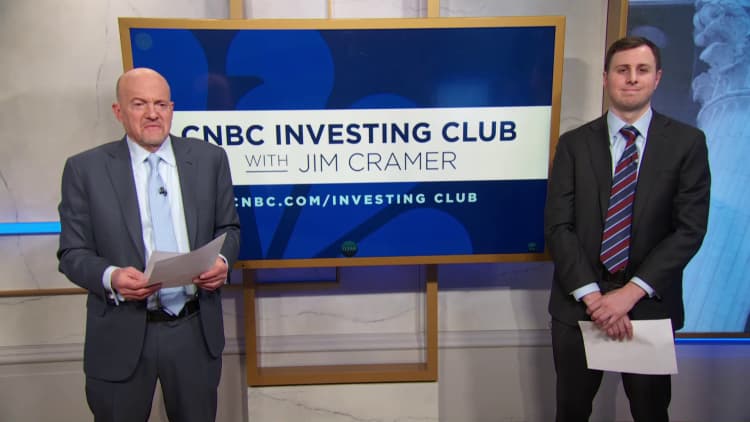
Jim Cramer’s March 19, 2026 commentary represents a significant contrarian signal rooted in technical analysis principles. By advising investors to “hold their nose” and purchase equities, Cramer acknowledges market headwinds while pointing to statistical extremes that historically precede rallies [1].
The
The
Recent trading data [0] illustrates the conditions prompting Cramer’s commentary:
| Index | March 6 Close | March 19 Close | Decline |
|---|---|---|---|
| S&P 500 | 6,740.01 | 6,606.48 | -1.98% |
| NASDAQ | 22,387.68 | 22,090.69 | -1.33% |
| Dow Jones | 47,501.56 | 46,021.44 | -3.12% |
The Dow Jones Industrial Average experienced the steepest percentage decline among major indices, while the S&P 500’s 1.98% pullback occurred over 11 trading sessions of grinding weakness followed by a modest 0.35% recovery on March 19.
March 19 sector performance [0] revealed defensive positioning ahead of Cramer’s call:
- Technology: +1.86% (leading the recovery)
- Energy: +1.10% (geopolitical tailwinds)
- Consumer Defensive: -0.89% (rotation away from safety)
- Consumer Cyclical: -0.79%
This sector rotation pattern—tech leadership combined with energy strength—suggests investors positioning for a potential bounce rather than continuation of defensive posture.
Cramer’s “hold your nose” phrasing carries specific analytical weight. The expression implies acknowledging significant uncertainty while still recommending action based on statistical extremes. This contrasts with more cautious approaches that might recommend waiting for additional confirmation [1].
The historical reliability of extreme oversold readings varies based on broader market regime. As noted in market analysis [2], while such readings “often produce near-term bounces, the broader trend may remain weak” depending on underlying fundamental conditions.
Market breadth metrics present a concerning counterpoint to the oversold signal [4][5]. Fewer stocks trading above key moving averages and declining participation across sectors create a divergence between index performance and underlying stock health. This breadth deterioration suggests the rally potential may be limited to specific sectors rather than broad-based advancement.
Market analysis [3] indicates the market has shifted “from a benign, liquidity-driven advance to a more fragile macro regime defined by geopolitical supply-shock risk, tighter financial conditions, narrow leadership, and growing skepticism.” The Iran conflict and Hormuz Strait disruption continue introducing inflationary impulses through energy costs, creating uncertainty that technical signals alone cannot resolve.
The confluence of rich equity valuations, excess AI capital expenditure, and private credit deterioration creates structural vulnerability [3]. Even if the oversold bounce materializes, these fundamental concerns may cap upside potential and increase volatility.
- Statistically Extreme Readings: The S&P Short Range Oscillator at -7.87% and McClellan at -94 represent historically rare conditions that have preceded meaningful near-term rallies [2]
- Technical Recovery Setup: March 19’s modest +0.35% gain, led by technology (+1.86%), suggests early positioning for a potential bounce [0]
- Contrarian Historical Precedent: Extreme oversold readings outside bear markets typically generate one to two significant buy signals annually [2]
- Geopolitical Uncertainty: Iran conflict and Hormuz disruption continue creating energy price volatility and inflationary risk [3]
- Breadth Deterioration: Weak underlying participation undermines the sustainability of any rally [4][5]
- Liquidity Tightening: Market analysis indicates tightening financial conditions that may limit rally duration [3]
- Valuation Vulnerability: Rich equity multiples combined with structural concerns create downside exposure even during bounces [3]
- Signal Reliability Variation: Historical patterns show extreme readings produce near-term bounces but don’t guarantee sustained trend reversal [2]
The statistical rarity of current readings suggests the contrarian window may be time-sensitive. However, extreme oversold conditions can persist longer than anticipated during regime shifts, particularly when geopolitical factors amplify uncertainty.
This analysis synthesizes Cramer’s contrarian market commentary with technical indicators and broader market context [1][0]:
- S&P Short Range Oscillator: -7.87% (24-month low)
- McClellan Oscillator: -94 (statistically rare reading)
- S&P 500 decline: -1.98% over 11 trading sessions
- March 19 recovery attempt led by technology sector
- Dow Jones underperforming with -3.12% decline
- Breadth deterioration suggesting narrow participation
- No specific stock recommendations provided
- Rally timeframe unspecified
- Geopolitical risks not directly addressed by Cramer
- Historical signal reliability varies with market regime
The technical indicators provide a data-driven framework for understanding market positioning, but do not constitute specific investment recommendations. Market participants should consider broader fundamental factors, risk tolerance, and portfolio construction when evaluating opportunities in oversold conditions.
Insights are generated using AI models and historical data for informational purposes only. They do not constitute investment advice or recommendations. Past performance is not indicative of future results.
About us: Ginlix AI is the AI Investment Copilot powered by real data, bridging advanced AI with professional financial databases to provide verifiable, truth-based answers. Please use the chat box below to ask any financial question.