Fed's Goolsbee Prioritizes Inflation Over Unemployment in 'Fraught but Intense' Policy Environment
Unlock More Features
Login to access AI-powered analysis, deep research reports and more advanced features
About us: Ginlix AI is the AI Investment Copilot powered by real data, bridging advanced AI with professional financial databases to provide verifiable, truth-based answers. Please use the chat box below to ask any financial question.
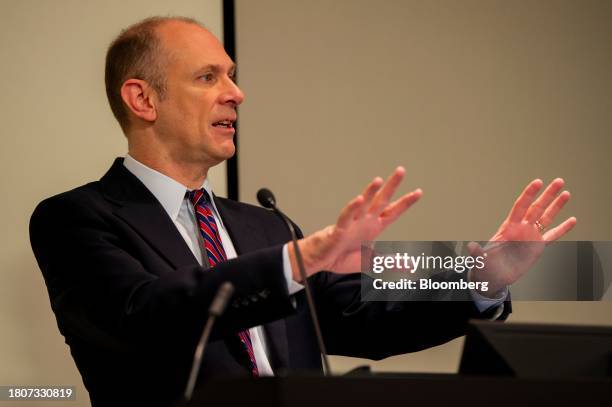
This analysis is based on the CNBC interview [1] published on March 23, 2026, in which Chicago Federal Reserve President Austan Goolsbee articulated a shifting policy stance that marks a notable departure from his previous advocacy for monetary easing. Goolsbee’s comments come at a critical juncture, with the Iran war showing progress but inflation remaining a persistent concern for policymakers.
The Federal Reserve’s policy trajectory in 2026 has become increasingly complex amid geopolitical uncertainties. While Governor Stephen Miran maintained his pre-war forecast of four rate cuts for 2026 [2], Goolsbee’s more hawkish tone suggests potential divisions within the FOMC about the appropriate policy response. This divergence highlights the challenging decision-making environment facing Fed officials as they balance multiple economic indicators and geopolitical risks.
Goolsbee’s explicit warning against “a repeat of the team-transitory mistake” [1] references the Fed’s 2021 error in underestimating inflation severity, signaling heightened sensitivity to being caught off-guard by price pressures again. This historical context provides important framing for understanding the Fed’s current cautious approach.
Market indices on March 23, 2026, reflected mixed trading patterns consistent with heightened uncertainty [0]:
- S&P 500: +0.17% (6,586.17) — modest recovery following a volatile week
- NASDAQ: -0.31% (21,928.30) — continued tech sector weakness
- Dow Jones: +0.97% (46,249.44) — strong relative performance
- Russell 2000: +1.31% (2,497.62) — small caps leading gains
The divergent performance between indices suggests investors are actively reassessing sector allocations in response to changing rate expectations. The Russell 2000’s outperformance may reflect expectations that a more hawkish Fed could benefit domestic-oriented small caps, while tech weakness aligns with reduced rate cut optimism that typically supports growth valuations.
Recent market volatility on March 18 and March 20 [0] indicates investors are processing significant uncertainty from both geopolitical developments and Fed policy dynamics. The current trading patterns suggest a market in consolidation mode, awaiting clearer signals on the inflation trajectory and Fed policy direction.
Goolsbee’s stance represents a significant evolution in his policy position. Having dissented on a rate cut in December 2025 [1] and agreed with the majority to hold rates steady in January and March 2026 FOMC meetings, his current emphasis on inflation concerns over unemployment marks a substantive shift in priorities.
The contrast with Governor Stephen Miran’s maintained forecast of four rate cuts [2] reveals potential policy divisions within the FOMC. While Miran’s position suggests confidence in the inflation trajectory returning to target, Goolsbee’s comments indicate a more cautious approach that prioritizes inflation risks even as labor market conditions remain relatively stable.
Christopher Waller’s similarly cautious approach [1] suggests a growing hawkish contingent within the Fed, potentially influencing future policy decisions. This alignment among multiple officials indicates the inflation narrative within the Fed may be strengthening, regardless of external geopolitical developments.
Goolsbee’s pivot from advocating for rate cuts to emphasizing inflation concerns represents one of the more notable Fed communication shifts of 2026. This change reflects both incoming economic data and the uncertain geopolitical environment created by the Iran conflict. The “fraught but intense” characterization suggests policymakers perceive elevated risks in their current decision-making environment.
The explicit reference to the 2021 “transitory” mistake signals that Fed officials are actively working to avoid a repeat of the policy error that allowed inflation to accelerate significantly. This historical awareness suggests Goolsbee and like-minded officials may be more responsive to early inflation signals, potentially leading to more aggressive policy responses if data deteriorates.
Goolsbee’s acknowledgment that the Fed could “raise rates if it was going a different way, and inflation was getting out of control” [1] depending on Iran war effects introduces significant tail-risk scenarios into rate cut expectations. This conditional language indicates the Fed is actively modeling multiple scenarios rather than committing to a predetermined policy path.
The difference between Miran’s four rate cut forecast and Goolsbee’s more cautious stance creates meaningful uncertainty for market participants. This divergence suggests the March FOMC minutes [1] will warrant particularly close examination for insights into the full range of views within the committee.
The core finding from this event is that a significant Fed official has shifted toward prioritizing inflation concerns over unemployment, marking a notable policy evolution that could influence the broader Fed trajectory in 2026. Goolsbee’s characterization of the policy environment as “fraught but intense” [1] captures the elevated uncertainty facing monetary policymakers.
Key data points supporting this analysis include Goolsbee’s dissent on the December 2025 rate cut [1], his agreement with rate holds in January and March 2026, and his explicit warning against repeating the 2021 transitory mistake. The contrast with Miran’s maintained four rate cut forecast [2] highlights meaningful divisions within the FOMC that could influence upcoming policy decisions.
Market participants should monitor upcoming CPI data releases, FOMC meeting minutes, and additional Fed speeches for further clarity on the evolving policy consensus. Energy price movements tied to Iran developments will remain a critical input for inflation projections.
The current market reaction—mixed indices with small cap strength and tech weakness—suggests investors are beginning to price in reduced rate cut probability while adjusting sector allocations accordingly.
Insights are generated using AI models and historical data for informational purposes only. They do not constitute investment advice or recommendations. Past performance is not indicative of future results.
About us: Ginlix AI is the AI Investment Copilot powered by real data, bridging advanced AI with professional financial databases to provide verifiable, truth-based answers. Please use the chat box below to ask any financial question.