Industry Analysis: Google's AI Infrastructure Expansion and Cloud Sector Impact
Unlock More Features
Login to access AI-powered analysis, deep research reports and more advanced features
About us: Ginlix AI is the AI Investment Copilot powered by real data, bridging advanced AI with professional financial databases to provide verifiable, truth-based answers. Please use the chat box below to ask any financial question.
Related Stocks
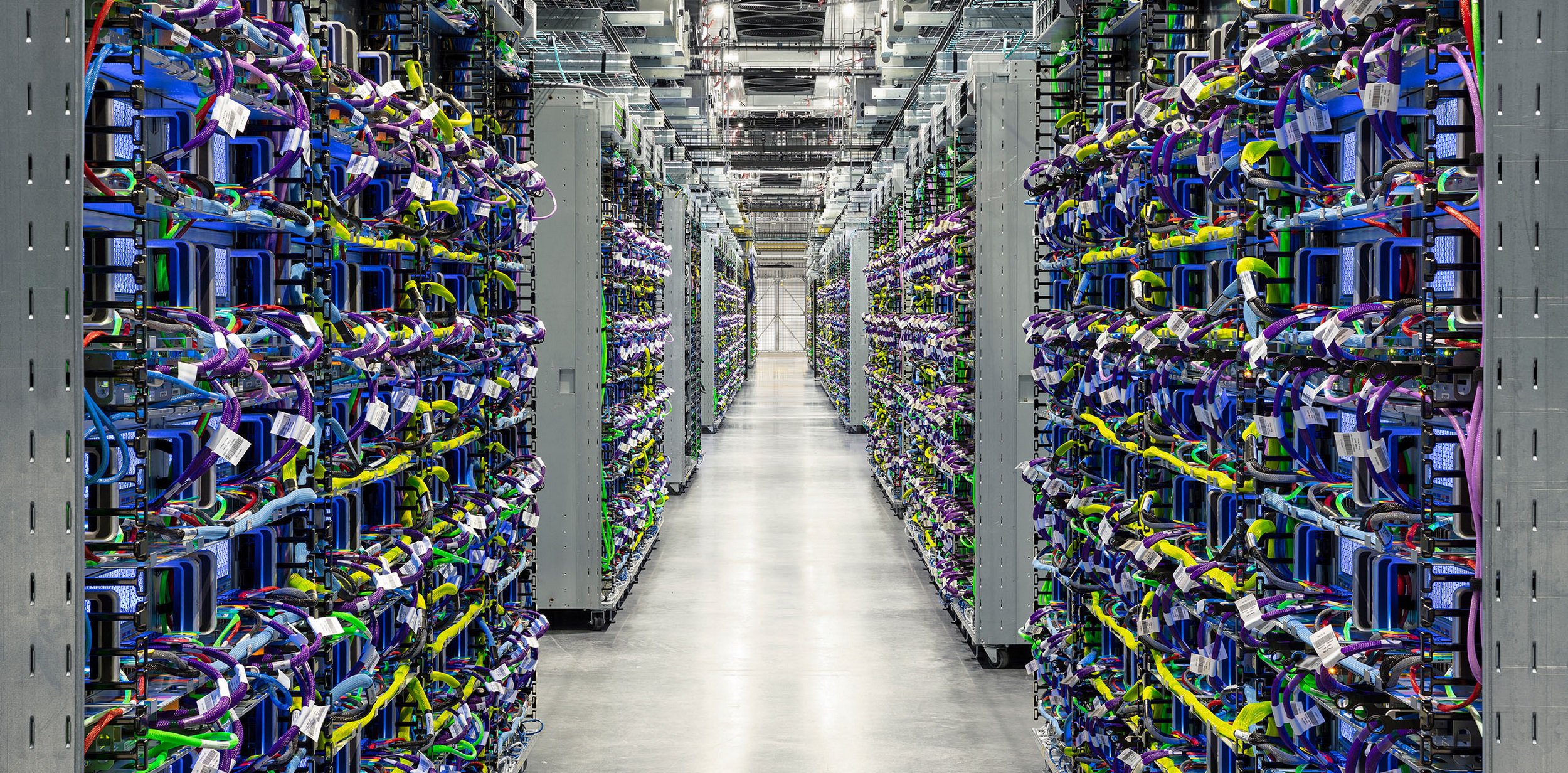
On November 22, 2025 (EST), Google’s VP of AI Infrastructure Amin Vahdat announced the company’s plan to double AI serving capacity every six months to reach a 1000x scale by 2029-2030 [1]. This move reflects unmet demand for AI services and underscores the shift from model training to serving capacity as the critical bottleneck in the AI industry [2]. Google’s 2025 capex is raised to $91-93B to fund this expansion, leveraging its custom Ironwood TPUs (inference-optimized, 4.6 petaFLOPS FP8 performance) to reduce reliance on NVIDIA GPUs [1,3]. The global AI infrastructure market is projected to grow from $135.81B (2024) to $394.46B (2030) at a 19.4% CAGR, with AI-optimized IaaS spending reaching $18.3B in 2025 and $37.5B in 2026 [5].
- Shift to Inference: The industry is entering “stage two of AI” where serving capacity (user access to models) is more critical than compute (model training) [2]. Google’s Ironwood TPUs, designed explicitly for inference, give it a cost and latency advantage over competitors using off-the-shelf GPUs [3].
- Capex Race: Big tech firms (Google, AWS, Microsoft) will spend over $400B on AI infrastructure in 2025, with AWS ($38B OpenAI deal) and Microsoft (39% YoY Azure growth) intensifying competition [1,7,8].
- Market Consolidation: High capex requirements (Google’s $93B 2025 spend) limit new entrants, consolidating the market among hyperscalers (AWS ~30%, Azure ~20%, Google Cloud ~13% market share) [4].
- Capex Pressure: Aggressive capacity expansion may lead to short-term margin pressure for Google and other hyperscalers [1].
- Capacity Constraints: Cloud customers face short-term capacity issues, with providers prioritizing regions and workloads [4].
- Physical Limits: Power, cooling, and networking constraints may slow down capacity expansion [2].
- Upstream Demand: Increased need for HBM, liquid cooling systems, and custom chip components benefits hardware suppliers [0,3].
- Edge AI: Startups can leverage niche opportunities in edge AI (low-latency workloads) to avoid large-scale data center investments [2].
- Ecosystem Partnerships: Collaborations between cloud providers and AI model developers (e.g., OpenAI-AWS/Azure) are critical for securing long-term workloads [8].
- Market Growth: Global AI infrastructure market to grow at 19.4% CAGR (2024-2030) [5].
- Capex Spending: Google’s 2025 capex: $91-93B; AWS/Microsoft combined 2025 AI infrastructure spend: $240B [1,4].
- Competitive Landscape: AWS (~30%), Azure (~20%), Google Cloud (~13%) market share [4].
- Custom Chips: Google’s Ironwood TPUs outperform NVIDIA’s H100 in inference latency [3].
Insights are generated using AI models and historical data for informational purposes only. They do not constitute investment advice or recommendations. Past performance is not indicative of future results.
About us: Ginlix AI is the AI Investment Copilot powered by real data, bridging advanced AI with professional financial databases to provide verifiable, truth-based answers. Please use the chat box below to ask any financial question.