Structured Analytical Report: OpenAI vs Google Competitive Dynamics & Financial Viability
Unlock More Features
Login to access AI-powered analysis, deep research reports and more advanced features
About us: Ginlix AI is the AI Investment Copilot powered by real data, bridging advanced AI with professional financial databases to provide verifiable, truth-based answers. Please use the chat box below to ask any financial question.
Related Stocks
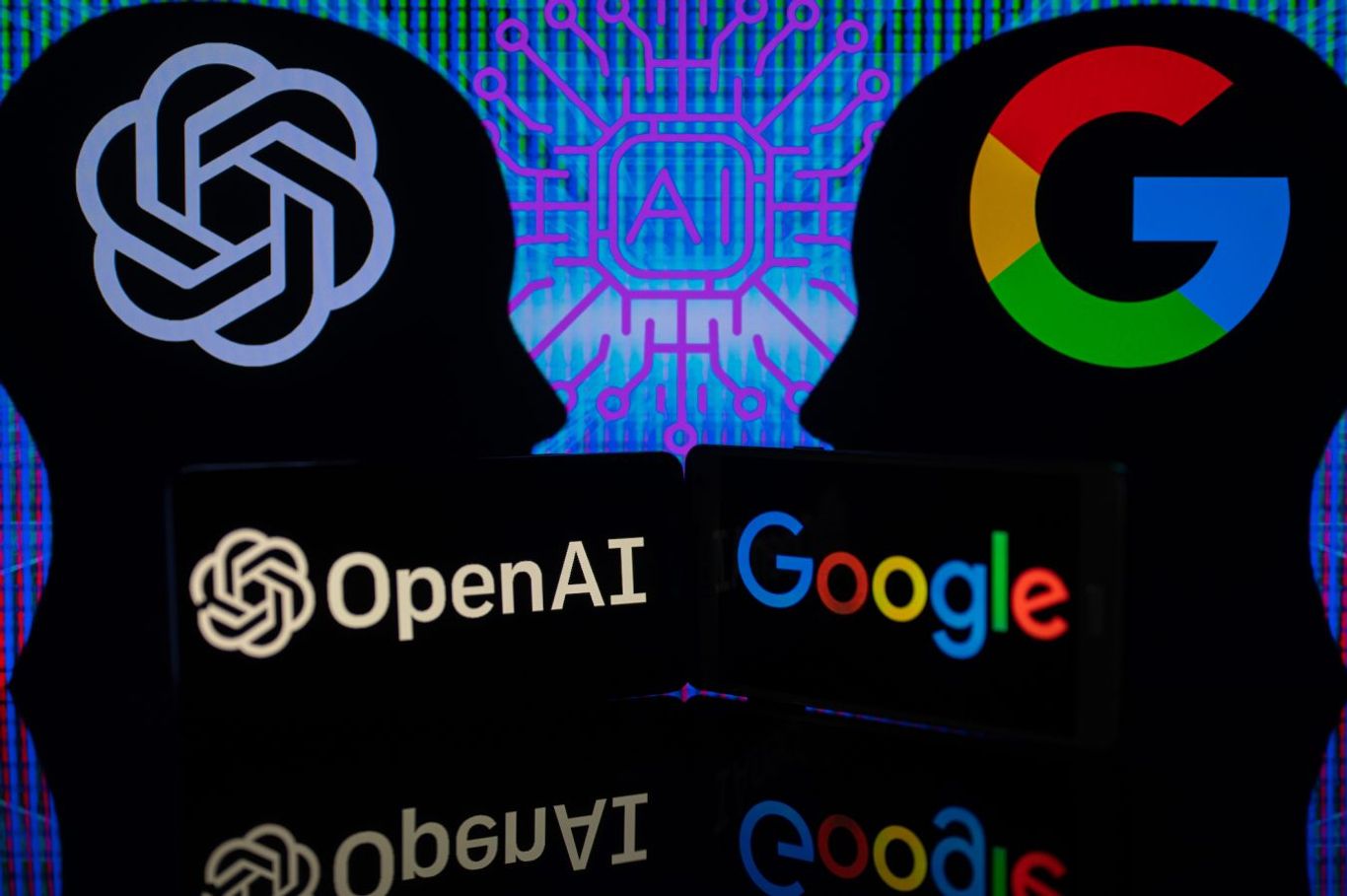
This report analyzes a Reddit discussion and linked article highlighting OpenAI CEO Sam Altman’s warning of “headwinds” from Google’s resurgence in AI. Key bearish arguments include Google’s superior data/infrastructure advantage, OpenAI’s unsustainable cash burn from its for-profit shift, Google’s stronger ecosystem integration, and OpenAI’s dependency on Microsoft for survival. The analysis draws on verified financial data, competitive intelligence, and partnership details from credible sources.
- Google’s Data/Infrastructure Advantage: Google’s Gemini 3 outperformed OpenAI’s GPT-5 in over a dozen categories (complex reasoning, scientific knowledge) [4], leveraging its full-stack infrastructure (own TPUs, cloud, and 1.5B-user Search platform) [1][3][8].
- Unsustainable Cash Burn: OpenAI generated $4.3B in H1 2025 revenue but burned $9B in cash [5], with a net loss of $13.5B [6]. Its 2025 cash burn rate is 70% of revenue [5].
- Google’s Ecosystem Dominance: Google integrates Gemini 3 into its product suite (Search, Workspace, Android) [1][4], while OpenAI relies primarily on ChatGPT [2][3].
- Microsoft Dependency: Microsoft owns a 27% stake in OpenAI (valued at $135B) [9][10][11], with new partnership terms solidifying their collaboration [9].
Google’s Gemini 3 has reclaimed AI leadership by outperforming GPT-5 in scientific reasoning (chemistry, biology) and complex problem-solving [4]. Unlike OpenAI, Google controls its entire AI stack: custom TPUs for training/inference, Google Cloud for scalability, and a global ecosystem of 1.5B+ users for Search AI summaries [1][8]. This integration allows Google to distribute Gemini across high-margin products (Workspace, Android) without relying on third-party infrastructure [3][4].
OpenAI’s shift to a for-profit model has led to exponential cash burn: $9B in H1 2025 (70% of revenue) [5], driven by $8.67B in inference costs (Azure) and $6B in stock-based compensation [6][7]. Its 2030 profitability forecast ($200B revenue, 60% margins) is criticized as “dotcom-era extrapolation” by GQG Partners [6]. OpenAI’s cash reserves are unclear—reports vary from $9.6B (end-June2025) [7] to $1B before fundraising [7], indicating potential liquidity risks.
OpenAI’s core product (ChatGPT) lacks the breadth of Google’s ecosystem. Google’s Gemini integration into Search (1.5B users) and Workspace gives it a competitive moat [8], while OpenAI’s growth is limited to ChatGPT’s paid tiers ($20/month Plus, $200/month Pro) [2]. This gap is exacerbated by open-source models (e.g., China’s Kimi K2) that are matching closed-source performance [6].
Microsoft’s 27% stake ($135B valuation) [9][11] provides OpenAI with critical infrastructure (Azure) and funding. The new partnership terms allow OpenAI to operate as a public benefit corporation (PBC) while preserving Microsoft’s access to its models [10]. However, full acquisition remains a plausible outcome if OpenAI’s valuation declines or cash burn accelerates [3][6].
- Liquidity Risk: OpenAI’s $9B H1 cash burn [5] could deplete reserves by early 2026 unless Microsoft injects additional funds or OpenAI raises capital at a lower valuation.
- Profitability Pressure: GQG warns that AI may only improve margins by 50–70 basis points by 2030 [6], making OpenAI’s 60% margin target unrealistic.
- Market Share Erosion: Google’s Gemini 3 adoption (integrated into Search) [8] could reduce ChatGPT’s user base. Enterprise clients may shift to Gemini for better integration with Google Workspace [4].
- Innovation Race: OpenAI must accelerate GPT-5.1 development to catch up with Gemini 3, but this will increase R&D costs [1][3].
- Independence vs Survival: OpenAI’s survival depends on Microsoft’s support, but full acquisition would mean loss of autonomy [9][11].
- Valuation Risk: If cash burn continues, OpenAI’s valuation could drop from $135B to $1B (as predicted by some analysts) [3][6], making acquisition by Microsoft more likely.
- Financial Metrics: H12025 Revenue = $4.3B; Cash Burn = $9B; Net Loss = $13.5B [5][6].
- Competitive Metrics: Gemini3 outperformed GPT5 in 12+ categories [4]; Google Search AI summaries have 1.5B monthly users [8].
- Partnership Metrics: Microsoft’s stake =27% ($135B valuation) [9][11].
- Infrastructure: OpenAI relies on Azure for 100% of its inference needs [7][11].
Insights are generated using AI models and historical data for informational purposes only. They do not constitute investment advice or recommendations. Past performance is not indicative of future results.
About us: Ginlix AI is the AI Investment Copilot powered by real data, bridging advanced AI with professional financial databases to provide verifiable, truth-based answers. Please use the chat box below to ask any financial question.