Carl Icahn Net Worth Collapse: Hindenburg Research Attack Triggers 75% Fortune Decline
Unlock More Features
Login to access AI-powered analysis, deep research reports and more advanced features
About us: Ginlix AI is the AI Investment Copilot powered by real data, bridging advanced AI with professional financial databases to provide verifiable, truth-based answers. Please use the chat box below to ask any financial question.
Related Stocks
This analysis examines the dramatic collapse of Carl Icahn’s personal fortune following a short-seller attack by Hindenburg Research. The event, reported on November 5, 2025, reveals how a single research report triggered a catastrophic 75% decline in one of Wall Street’s most storied activist investors’ net worth [1].
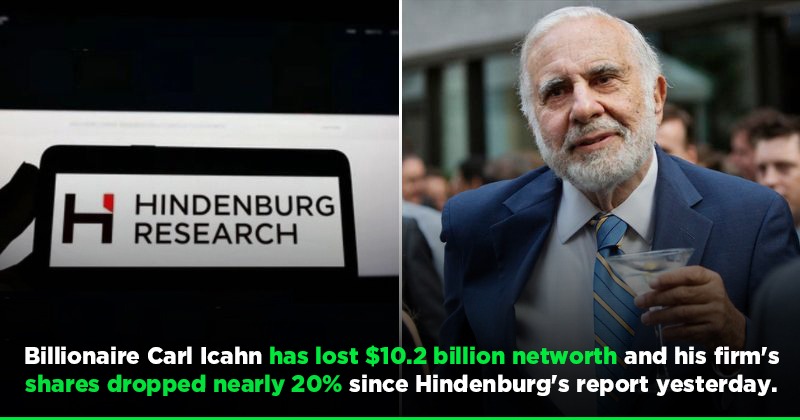
The Hindenburg Research report on May 2, 2023, immediately devastated Icahn Enterprises (IEP), causing a 20% single-day plunge that erased approximately $10 billion from Icahn’s personal fortune [2]. The long-term damage has been even more severe - IEP shares have declined 82.69% from January 2023 to November 2025, falling from $51.00 to $8.83 [0]. The company now trades with a market cap of $5.06B, representing over 28% decline from its 52-week high [0].
Financial metrics paint a concerning picture: IEP currently shows negative profitability with ROE of -22.12%, net profit margin of -6.69%, and operating margin of -2.65% [0]. The P/E ratio of -7.40x indicates significant earnings challenges, while daily volatility of 3.36% reflects ongoing market uncertainty [0].
Hindenburg Research’s report made several explosive claims [4]:
- IEP units were allegedly “overvalued by more than 75%” and traded at a “218% premium to its last reported net asset value”
- The report accused Icahn of operating a “Ponzi-like” structure using “money taken in from new investors to pay out dividends to old investors”
- Despite negative free cash flow of $4.9 billion since 2014, IEP paid $1.5 billion in cash dividends
Icahn Enterprises vehemently rejected these allegations, with Icahn calling Hindenburg “more aptly named Blitzkrieg Research” and accusing them of launching “disinformation campaigns” [5]. The company cited $1.9 billion in cash and $4 billion in additional liquidity as evidence of financial strength [5].
IEP later paid $1.5M to settle SEC charges related to stock pledge accounting, though the settlement made “no claim IEP or I inflated NAV or engaged in a ‘Ponzi-like’ structure” [3]. Despite these challenges, IEP showed some recent positive signs in Q3 2025, reporting $287 million net income (up sharply from previous year), EPS of $0.49 beating estimates, and maintaining a quarterly distribution of $0.50 per share [6]. The company’s indicative net asset value increased by $567 million during Q3 2025 [6].
The analysis reveals a critical leverage vulnerability - Icahn reportedly “pledged more than half his holdings in Icahn Enterprises as collateral for personal margin loans” [1]. This creates potential forced selling pressure if stock prices decline further, creating a dangerous feedback loop that could exacerbate losses.
Despite recent dividend declarations, fundamental questions remain about IEP’s ability to sustain its 15.8% dividend yield [4]. The historical pattern of negative free cash flow combined with substantial dividend payments creates sustainability concerns that recent Q3 improvements may not fully resolve.
This event highlights the evolving landscape of activist investing, where even established figures like Icahn face intense scrutiny from sophisticated short-sellers. The attack demonstrates how modern financial research can rapidly undermine even the most established market players, reflecting increased market efficiency and information transparency.
- Leverage vulnerability: The high level of pledged shares as collateral creates potential for forced liquidation [1]
- Dividend sustainability concerns: Despite recent improvements, the fundamental question of cash flow adequacy remains [4]
- Regulatory uncertainty: Ongoing SEC scrutiny and potential additional penalties could further impact the company [3]
- Leadership transition risks: At age 89, Icahn’s succession planning remains unclear, creating operational uncertainty [1]
- Cash flow generation: Quarterly free cash flow coverage of dividend payments
- Asset valuation verification: Independent assessment of private investment marks
- Margin loan compliance: Monitoring of personal leverage arrangements and covenant requirements
- Regulatory developments: SEC investigation outcomes and potential enforcement actions
- Executive stability: Further departures or succession planning announcements
The collapse of Carl Icahn’s net worth represents one of the most dramatic falls from grace in modern financial history, driven by Hindenburg Research’s May 2023 short-seller attack [1]. While recent Q3 2025 results show operational improvement with $287 million net income and maintained dividends [6], fundamental questions about IEP’s valuation methodology, dividend sustainability, and leverage structure remain unanswered.
The combination of high leverage (with over half of Icahn’s IEP holdings pledged as collateral) [1], contested valuations (Hindenburg’s claim of 75% overvaluation) [4], and regulatory scrutiny (SEC settlement) [3] creates a complex risk profile. Current negative profitability metrics (-22.12% ROE, -6.69% net margin) [0] and the stock’s 82.69% decline since January 2023 [0] underscore the severity of the situation.
Insights are generated using AI models and historical data for informational purposes only. They do not constitute investment advice or recommendations. Past performance is not indicative of future results.
About us: Ginlix AI is the AI Investment Copilot powered by real data, bridging advanced AI with professional financial databases to provide verifiable, truth-based answers. Please use the chat box below to ask any financial question.