Amazon's Leaked Automation Plan: 600k Future Roles Replaced by Robots for $0.30 Per Item Savings
Unlock More Features
Login to access AI-powered analysis, deep research reports and more advanced features
About us: Ginlix AI is the AI Investment Copilot powered by real data, bridging advanced AI with professional financial databases to provide verifiable, truth-based answers. Please use the chat box below to ask any financial question.
Related Stocks
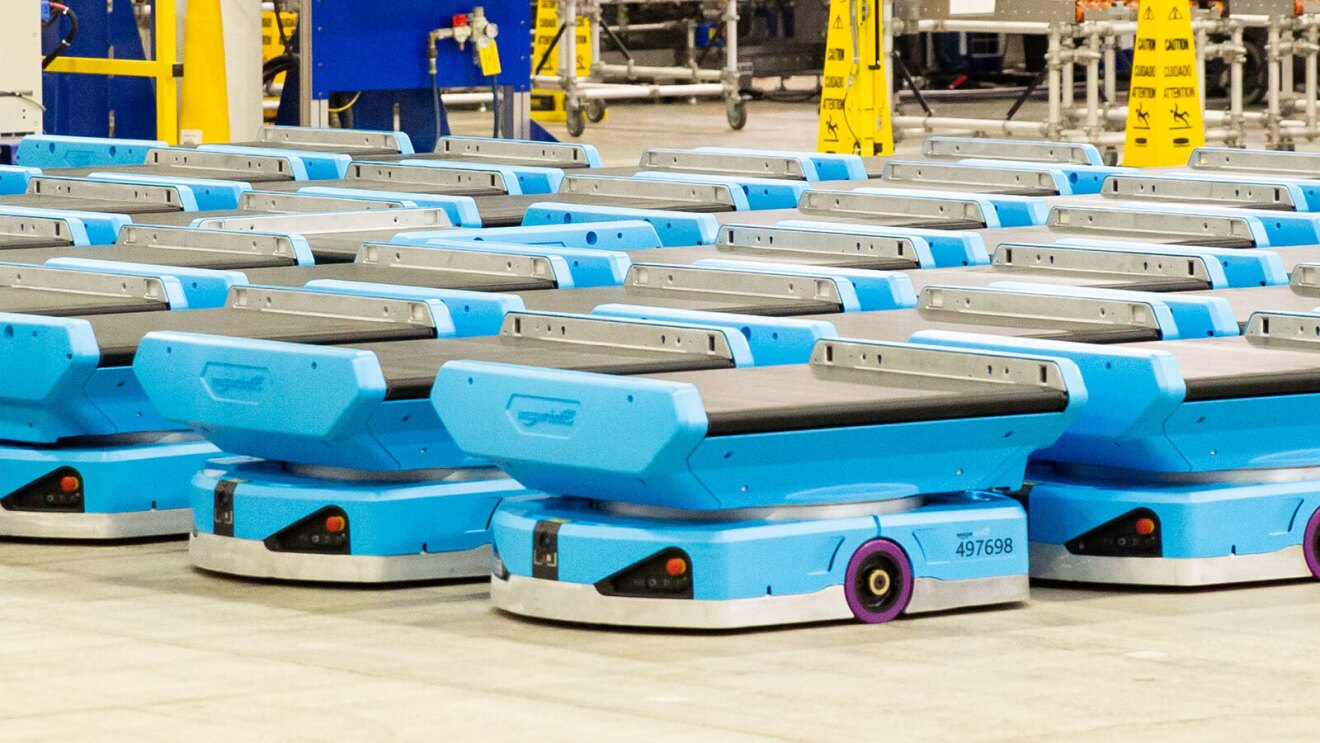
Leaked internal documents reveal Amazon’s robotics team targets 75% automation of operations, replacing up to 600k future warehouse roles by 2033 and 160k by 2027, with projected savings of $0.30 per item (totaling $12.6B over 2025-2027) [1][2][3]. The initiative has already impacted market sentiment: AMZN closed up 1.63% on 2025-11-22 with above-average volume (65.55M vs. 47.19M avg) [0], reflecting investor optimism about margin expansion. Amazon’s 2024 net profit margin of 11.06% [0] suggests these savings could significantly boost profitability, though the company notes the documents do not represent its overall strategy [1]. The plan also has sector implications, potentially benefiting robotics and AI chip suppliers while raising concerns for labor-intensive retail logistics [0].
- Financial Impact: The $0.30 per item savings represents ~5% of Amazon’s 2024 total revenue ($514B) over three years, highlighting material margin expansion potential [0][2].
- Market Sentiment: The stock’s gain on higher volume indicates investors prioritize long-term profitability over short-term execution risks [0].
- Cross-Sector Spillover: The automation push may drive growth in upstream sectors like warehouse robot manufacturing and AI chip supply [0].
- Timeline Nuance: The 600k role replacement refers to future hires, not immediate layoffs, which mitigates short-term labor disruption risks [2][3].
- Margin Expansion: The $0.30 per item savings could enhance Amazon’s net profit margin, supporting long-term shareholder value [0][2].
- Capex Shift: A move toward automation may optimize capital allocation, reducing reliance on labor-intensive operations [0].
- Sector Growth: Robotics and AI sectors may benefit from increased demand for warehouse automation solutions [0].
- Labor Unrest: Future role replacements could trigger strikes or unionization efforts, disrupting operations [1].
- Execution Risk: Scaling robot technology may lead to cost overruns or delays, as seen in past automation projects [3].
- Regulatory Scrutiny: Governments may impose automation taxes or restrictions (e.g., EU’s AI Act) [2].
- Reputational Harm: Negative public perception of job losses could erode brand loyalty [1].
- Savings: $0.30 per item, $12.6B projected over 2025-2027 [2].
- Stock Performance: AMZN up 1.63% on 2025-11-22 with 65.55M volume (above average) [0].
- Analyst Consensus: 90.4% Buy rating, $300 consensus target (+35.9% upside) [0].
- Automation Target: 75% of operations automated by 2033, with 40 facilities adopting the Shreveport model by 2027 [2].
- Info Gaps: Unclear capex requirements, long-term maintenance costs, regulatory response, and union reactions [0][1][2][3]
Insights are generated using AI models and historical data for informational purposes only. They do not constitute investment advice or recommendations. Past performance is not indicative of future results.
About us: Ginlix AI is the AI Investment Copilot powered by real data, bridging advanced AI with professional financial databases to provide verifiable, truth-based answers. Please use the chat box below to ask any financial question.